 ultimate-guide
GIA Diamond Certification Explained for Buyers
Table of Contents
- Why GIA Certification Matters When You Buy a Diamond
- How to Read a GIA Diamond Report, Section by Section
- GIA vs IGI Diamond Certification: What Buyers Should Know
- Verifying GIA Diamond Laser Inscription Before You Commit
- How GIA Grading Shapes Diamond Value and Your Budget
- Common Misunderstandings About Diamond Certification
- Conclusion
- Frequently Asked Questions
Last Updated: September 30, 2026
Why GIA Certification Matters When You Buy a Diamond
GIA diamond certification explained for buyers begins with one fact: it is an independent grading report issued by the Gemological Institute of America, the laboratory that created the modern diamond grading system. It describes a stone's weight, colour, clarity and cut against a consistent standard, so you are not relying on the word of whoever is selling it.
That independence is the whole point. At MARA Bridal Luxury Jewellery, we have spent more than 15 years working with diamonds, and the single most common mistake we see is buyers treating a certificate as paperwork rather than as the buyer's protection.
A diamond without a recognised report is an opinion. A diamond with one is a documented set of measurements you can compare against any other stone, anywhere.
GIA's official guidance on diamond grading reports
How to Read a GIA Diamond Report, Section by Section
Learning how to read a GIA diamond report takes about ten minutes, and it is the highest-return ten minutes in the entire buying process. The report follows a fixed structure, so once you understand the layout you can read any GIA document at a glance.
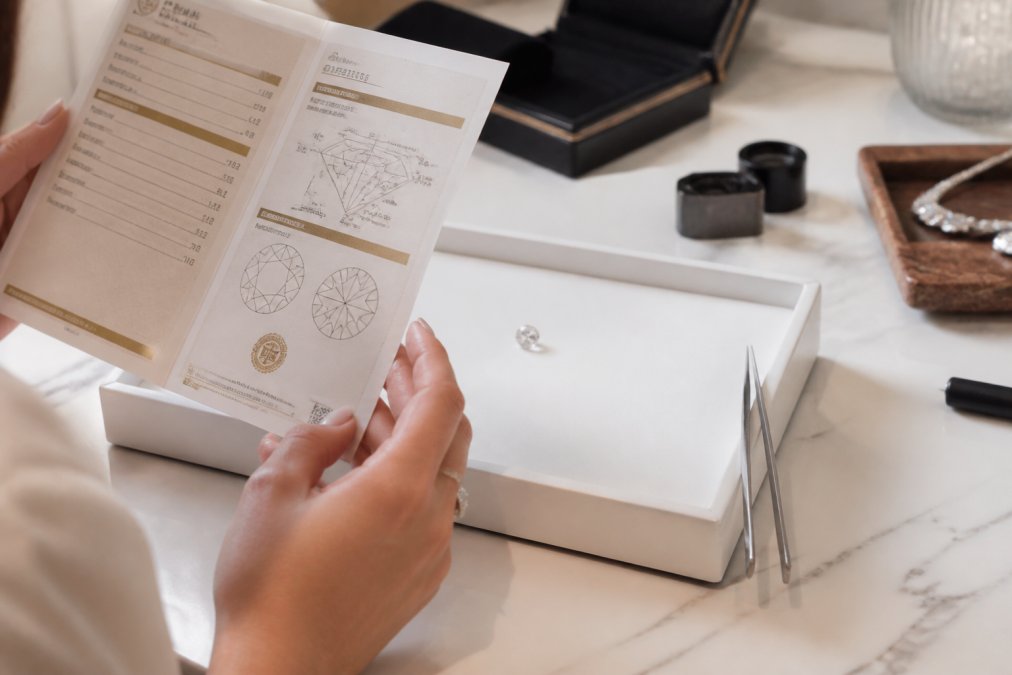
Start with the report number and the shape and measurements at the top. Then work down through the grading scales: carat weight, colour grade, clarity grade and cut grade. The proportions diagram and the clarity characteristics plot come next, followed by any comments the grader has added.
The report number matters more than most buyers realise. It links the paper to one specific stone, and it should match the inscription on the diamond's girdle.
The Four Cs as They Appear on the Report
The Four Cs appear as four separate graded fields, and each one is measured differently. Carat weight is a precise figure. Colour runs from D to Z. Clarity runs from Flawless down through the included grades. Cut is graded from Excellent to Poor on the report's own scale.
Cut is the one buyers undervalue most. A stone with a modest colour grade and an Excellent cut will often outperform a higher-coloured stone with a poor cut in the way it handles light. If you are choosing between two similar diamonds, look at cut first.
Additional Grading Notes and Comments
The comments section is where the useful detail hides. Fluorescence, surface graining, and any treatments applied to the stone are noted here rather than in the main grid.
A common mistake is skipping straight past this section because it looks technical. Read it. If a comment mentions a treatment, ask what it means before you go further.
GIA vs IGI Diamond Certification: What Buyers Should Know
The GIA vs IGI diamond certification question comes up in almost every consultation, and with GIA diamond certification explained for buyers, the honest answer is that both are legitimate laboratories with different reputations and different strengths.
The GIA is a non-profit research and grading institution, and its standards are widely treated as the reference point for the trade. IGI is a commercial laboratory that grades a very large volume of stones, particularly lab-grown diamonds, and its reports are common in that market.
Neither is a red flag. What matters is consistency: a report from either lab gives you a documented basis for comparison, and a stone with no recognised report gives you nothing.
Verifying GIA Diamond Laser Inscription Before You Commit
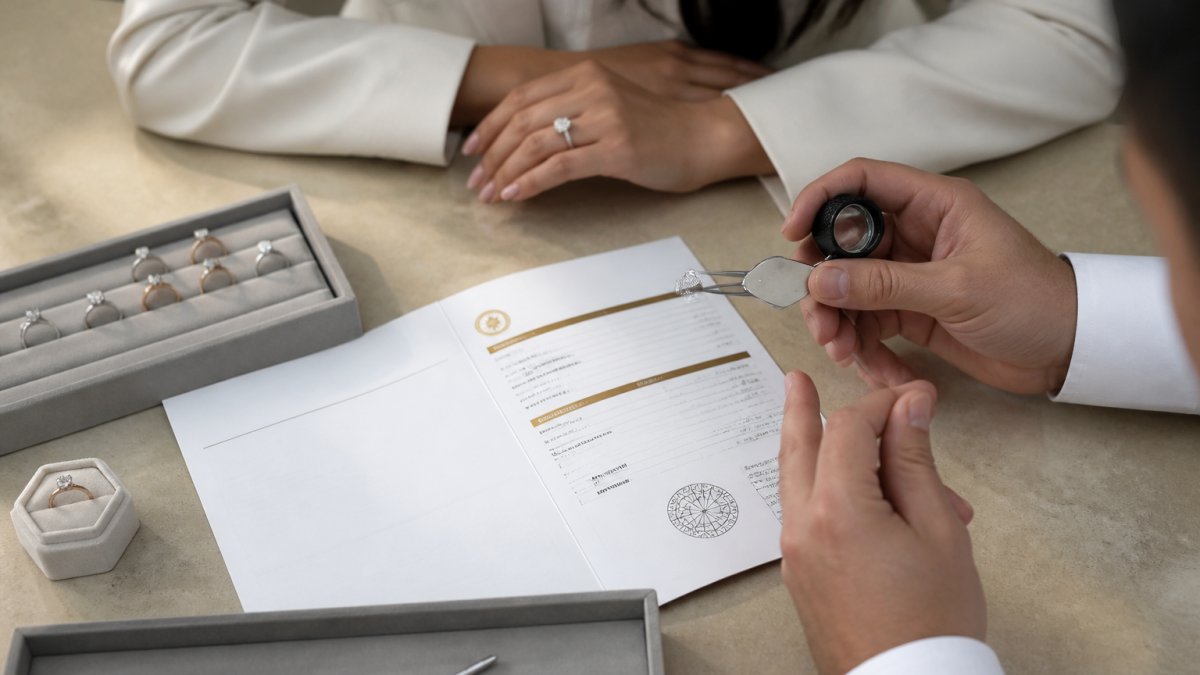
Verifying GIA diamond laser inscription is the step that connects the paper report to the physical stone in front of you. The GIA inscribes the report number on the diamond's girdle using a laser, and that number should match the report exactly.
Ask to see the inscription under magnification. A jeweller should be able to show you the girdle with a loupe or a gemmological microscope without hesitation. If the number does not match, or the stone has no inscription, stop and ask why.
Some older stones were graded before inscription became standard practice, so a missing inscription is not automatically a problem. It does mean you should confirm the match through the report's other identifying details, such as exact measurements and the clarity plot.
How GIA Grading Shapes Diamond Value and Your Budget
Grading shapes value because it removes ambiguity, and ambiguity is expensive. Two diamonds of identical carat weight can sit at very different points on a price scale depending on their colour, clarity and cut grades, and the report is what lets you see why.
This is where budget planning gets practical. Moving one clarity grade down, from a grade where inclusions are visible under magnification to one where they are not, often frees up budget without any visible difference to the eye. The same logic applies to colour.
What most guides miss is that the cut grade is the one you should protect. Spend your budget on cut first, then carat, then colour and clarity. A well-cut diamond at a lower colour grade looks better than a poorly cut one at a higher grade, every time.
Common Misunderstandings About Diamond Certification
The most persistent misunderstanding is that a certificate guarantees quality. It does not. A GIA report describes a diamond accurately; it does not tell you whether that description represents good value, and it does not make a poorly cut stone into a good one.
A second misunderstanding is that lab-grown diamonds cannot be certified. They can, and they are, by the GIA and other laboratories.
| Misunderstanding | What Is Actually True | Why It Matters |
|---|---|---|
| A certificate guarantees quality | It documents the stone's characteristics | You still need to judge cut and value |
| Lab-grown stones cannot be certified | They are graded by major laboratories | You can compare them on equal terms |
| A report is the same as an appraisal | Grading describes, appraisal values | You need both, for different purposes |
| Any paperwork counts | Only independent reports are comparable | In-house documents offer no accountability |
Conclusion
The gap between a confident purchase and a nervous one usually comes down to documentation. A diamond with an independent report, a matching inscription and a jeweller willing to walk you through both is a diamond you can buy without second-guessing yourself.
Frequently Asked Questions
Why is GIA certification considered the gold standard for diamonds?
The Gemological Institute of America created the Four Cs and grades every diamond against the same criteria, whether it belongs to a retailer or a private client. Because the GIA does not buy or sell diamonds, its grading is independent. Each report carries a unique number you can check online, which is why so many buyers treat GIA certification as the benchmark when comparing stones.
What information is included on a GIA diamond grading report?
A full report records the stone's measurements, carat weight, colour grade, clarity grade, cut grade, polish, symmetry and any fluorescence. It also notes treatments, such as whether the diamond has been laser-drilled or fracture-filled, plus a plotting diagram of internal features. That combination lets you judge how to read a GIA diamond report rather than relying on a seller's summary.
Is a GIA certificate the same as a diamond appraisal?
No. A GIA report describes the diamond's quality; it does not state a monetary value. An appraisal is a separate valuation, usually prepared for insurance, that assigns a valuation figure based on current market conditions. Buyers need both: the report confirms what the stone is, and the appraisal tells your insurer what it would cost to replace.
How can I verify the authenticity of a GIA report online?
Every GIA report has a unique number, and you can enter it on the GIA's Report Check service to confirm the details match the physical document. Ask to see the report before purchase, compare the number on the paper to the one inscribed on the diamond's girdle, and check that the measurements and grades align. If anything does not match, pause and ask questions.
Do lab-grown diamonds receive the same GIA grading standards as natural diamonds?
Yes. The GIA grades lab-grown diamonds using the same colour, clarity and cut criteria as natural stones, and clearly labels the report as laboratory-grown. The difference sits in origin and rarity, not in how the Four Cs are assessed. Buyers comparing GIA vs IGI diamond certification should note that both laboratories distinguish grown from natural on the report itself.
What is the difference between a GIA dossier and a full grading report?
A GIA Diamond Dossier covers stones roughly under one carat and includes the Four Cs, a laser inscription record and a plotting diagram, but omits the full clarity and colour characteristics section. A full grading report adds those details and a more detailed plot. For an engagement ring, a full report gives you more to review and compare.
Does GIA certification change how much a diamond costs?
Certification does not set the price, but it does influence it. A stone with a strong GIA report, particularly for cut, tends to command more than an equivalent ungraded diamond because buyers can trust the stated quality. When budgeting, treat the report as the document that lets you compare stones fairly rather than as a markup.