 how-to
Engagement Ring Budget on a $100,000 Salary
Table of Contents
- Why the Three-Month Salary Rule No Longer Decides Your Engagement Ring Budget
- What Actually Drives the Cost of an Engagement Ring
- Setting a Realistic Engagement Ring Budget on a $100,000 Income
- Lab-Grown vs Natural Diamond Price Comparison
- Inside the Bespoke Engagement Ring Design Process
- East-West Setting Engagement Ring Pros and Cons
- Balancing a Luxury Ring With Your Other Financial Goals
- Conclusion
- Frequently Asked Questions
Last Updated: September 11, 2026
Why the Three-Month Salary Rule No Longer Decides Your Engagement Ring Budget
The three-month salary rule is a marketing slogan from a 1930s advertising campaign, not a financial principle (adage.com). On a $100,000 income, it suggests spending roughly $25,000 on an engagement ring, a figure that ignores your savings, your partner's expectations, and the fact that lab-grown diamonds now offer identical optical properties at a fraction of the cost of natural stones.
This guide from MARA Bridal Luxury Jewellery covers what actually shapes an engagement ring budget, how to set one you can live with, and where your money delivers the most visible return. Below, we break down the real cost drivers, compare lab-grown and natural options, and walk through the bespoke design process so you can decide with confidence rather than convention.
What Actually Drives the Cost of an Engagement Ring
Cost comes down to four variables: the diamond, the metal, the setting style, and the craftsmanship behind it. Change any one and the total moves.
The Four Cs and What They Change About Price
Carat weight dominates pricing, but cut is what makes a diamond perform. A well-cut 1.00ct stone will out-sparkle a poorly cut 1.20ct every time, and it usually costs less. Clarity and colour sit further down the list, and both offer room to compromise. A diamond graded SI1 or VS2 with near-colourless tones looks identical to the naked eye beside a flawless stone, at a meaningfully lower figure. The Gemmological Institute of America's diamond grading guide explains how each grade is assessed, which helps you judge where to hold firm and where to flex.
Metal, Setting Style and Craftsmanship
Platinum costs more than white gold and wears differently over decades. Yellow and rose gold remain popular for their warmth and lower price point. Setting style changes both labour and material: a solitaire uses less metal and fewer hours than a halo or a three-stone design. Hand-finished settings, where a jeweller shapes and polishes each claw individually, cost more than cast pieces because of the time involved.
Setting a Realistic Engagement Ring Budget on a $100,000 Income
Start with what remains after tax, living costs, and existing commitments, not with a multiple of your salary. A $100,000 income in Australia sits in a middle tax bracket, so your take-home pay is well below the headline figure. Work from that number.
A practical method:
- List your monthly take-home pay
- Subtract rent or mortgage, living costs, and any debt repayments
- Set aside three to six months of expenses as an emergency fund
- Identify what you can save toward a ring over three to six months
- Cap the ring at that figure, or at one to two months of gross income, whichever is lower
Lab-Grown vs Natural Diamond Price Comparison
Lab-grown diamonds are chemically, physically, and optically identical to natural diamonds. The difference is origin: one forms in a laboratory over weeks, the other in the earth over billions of years. That distinction drives the price gap, which is substantial. A lab-grown stone of the same carat, cut, colour, and clarity typically costs a fraction of its natural counterpart, which means the same budget buys a noticeably larger or higher-graded diamond.
| Consideration | Lab-Grown Diamond | Natural Diamond |
|---|---|---|
| Origin | Grown in a laboratory | Formed in the earth |
| Relative cost | Lower | Higher |
| Size for same budget | Larger | Smaller |
| Resale value | Limited | Established market |
| Everyday appearance | Identical | Identical |
Neither option is "fake." Both are real diamonds, and both can be graded by independent laboratories. The right choice depends on whether you value size and value, or tradition and resale potential. MARA Bridal Luxury Jewellery offers both, so the decision stays yours rather than ours.
Inside the Bespoke Engagement Ring Design Process
A bespoke ring begins with a private consultation, either in person or by video, where you discuss style, budget, and the story you want the piece to carry. From there, your jeweller presents loose diamond options and sketches, you refine the design together, and the ring is crafted to your specification.
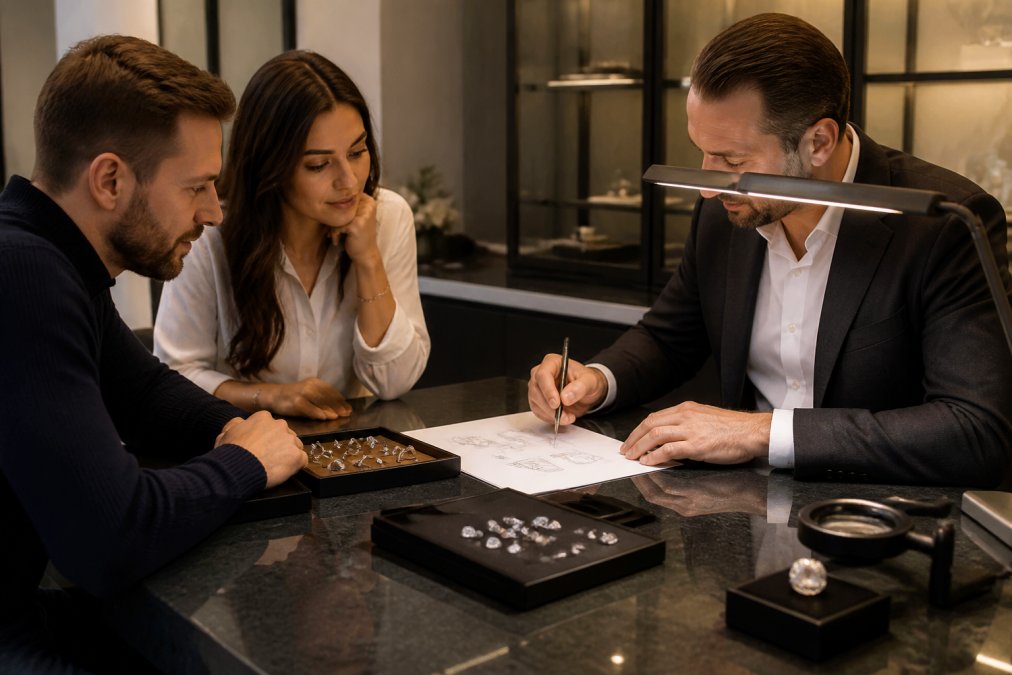
The process is collaborative, not prescriptive. You do not need a finished design in mind before you begin. What most guides miss is that the consultation itself shapes the brief: seeing stones in person, or through a virtual try-on, clarifies what you actually want far faster than browsing online.
East-West Setting Engagement Ring Pros and Cons
An east-west setting turns the diamond sideways, so its long axis runs across the finger rather than up and down it. The effect is modern and architectural, and it makes a given carat weight look larger because more of the stone sits across the band.
The advantages:
- Distinctive, contemporary look that stands apart from traditional solitaires
- Makes elongated cuts such as oval, marquise, and emerald appear larger
- Sits lower on the finger, which suits active hands
The trade-offs:
- Less conventional, so it may not suit every taste or every wedding band pairing
- Requires a well-matched band, since the horizontal stone changes the profile
- Resizing and restyling are less flexible than with a classic vertical setting
Balancing a Luxury Ring With Your Other Financial Goals
A ring is one purchase among several competing for the same money: a home deposit, a wedding, travel, investments. Treat it as a line item, not an exception. Decide what you can spend without borrowing, and hold to it. A higher budget does not automatically produce a better ring; a well-chosen stone in a setting that suits the wearer does, and that is achievable across many figures. The Australian Securities and Investments Commission's MoneySmart guidance offers a useful framework for weighing a large discretionary purchase against your broader goals.
Conclusion
The honest answer to how much you should spend is: whatever you can afford without compromising your financial stability, guided by cut quality and personal taste rather than a decades-old slogan. A $100,000 income supports a beautiful ring, whether you choose a larger lab-grown stone or a smaller natural one.
At MARA Bridal Luxury Jewellery, we design bespoke engagement rings with transparent pricing and genuine guidance, backed by more than 15 years in Australian fine jewellery. We offer both natural and lab-grown diamonds, private one-on-one consultations in person or by video, and a virtual try-on service so you can see the ring before you commit. Book a private consultation and let us help you create a piece that reflects your story.
Frequently Asked Questions
Is the three months' salary rule for engagement rings still relevant?
It began as a marketing slogan in the 1930s, not a financial principle, and most couples now treat it as a loose upper reference rather than a target. On a $100,000 salary it would suggest a very generous figure, yet a considered engagement ring budget should reflect your savings, your deposit goals and your comfort with repayments. Many couples spend well below that marker and put the difference towards a home or wedding. What matters is that the amount is planned, not improvised.
How do lab-grown diamonds affect engagement ring budgeting?
A lab-grown diamond of a given size and quality generally costs less than a natural diamond of comparable specification, so the same engagement ring budget can stretch to a larger stone or a more elaborate setting. That difference is a budgeting tool, not a compromise: lab-grown diamonds are real diamonds with the same optical and physical properties, and they can be graded to the same standards. A lab-grown vs natural diamond price comparison is the quickest way to see which route suits your priorities.
What factors influence the final cost of a bespoke engagement ring?
The diamond itself, chosen by carat, colour, clarity and cut, is usually the largest variable. Metal choice, setting complexity, hand-finishing and any engraving or personal details add to it. The bespoke engagement ring design process also affects timing, since revisions and custom CAD work take consultation time. Because these elements combine differently for every couple, MARA provides transparent guidance during a private consultation and current pricing details on its website.
How can I balance a luxury engagement ring purchase with other financial goals?
Set the ring aside from your deposit, emergency fund and superannuation contributions before you commit, then treat the remaining figure as your ceiling rather than your target. Spreading the decision across two or three consultations gives you time to compare options without pressure, and choosing a design you will still love in twenty years avoids the cost of replacing it later. A ring that fits comfortably within your broader plan is the one you will enjoy wearing.